
Sales leadership3 min read
From Hero Selling to Repeatable Selling
Founder-led sales is often the best way to get your first customers. But eventually, the thing that helped you grow can become the thing holding you back.
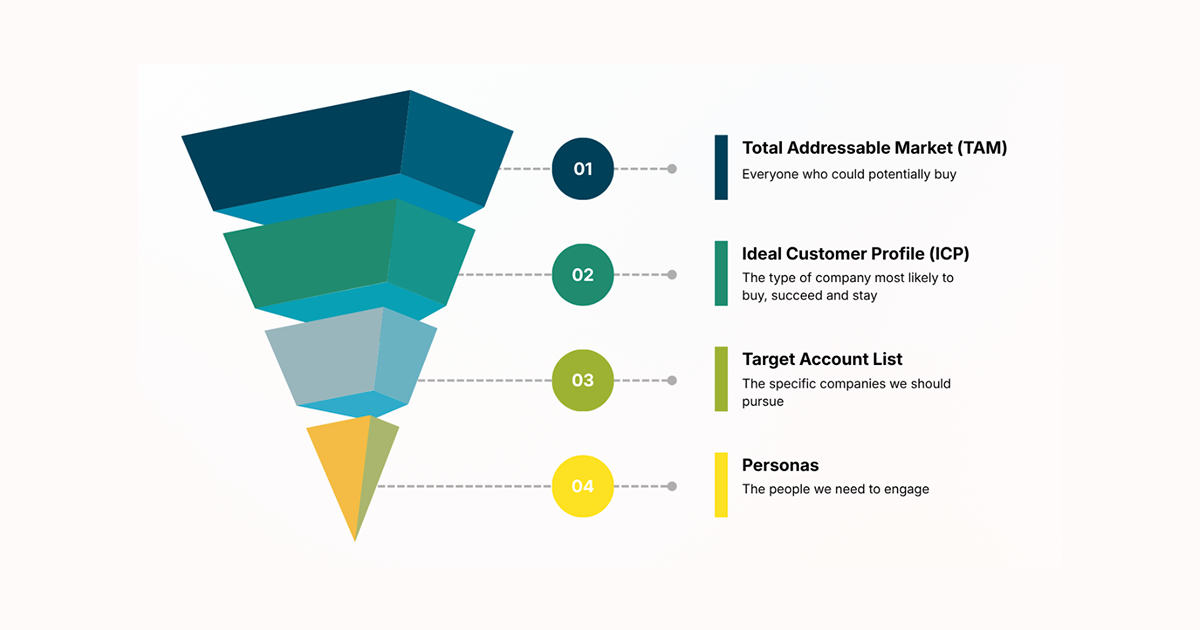
The clearer you are about who you're selling to, the easier it becomes to build a predictable sales engine.
One of the biggest mistakes I see in scaling B2B companies is trying to sell to too many different types of customers. The second biggest mistake is trying to sell to enterprise customers too early, but that will be the subject of another post.
The logic is understandable: "We can sell to anyone who has this problem."
But "anyone" is rarely a useful sales strategy.
A clearly defined Ideal Customer Profile (ICP) gives your sales and marketing teams a practical way to decide where to focus, who to prioritise and, perhaps even more importantly, who not to target.
Your ICP should influence almost every part of your go-to-market strategy.
It helps you decide:
It also makes sales more repeatable.
If your best customers all share certain characteristics, your sales team can deliberately look for more companies with those specific characteristics, rather than relying on individual judgement or whoever happens to respond to a scattergun-style outbound campaign.
The fastest-scaling B2B businesses are those that use data and account research to prioritise their highest-value opportunities rather than treating every prospect equally.
You don't need a 20-page ICP document. Start with the characteristics that genuinely differentiate your best customers.
At a minimum, consider:
This is often overlooked, but knowing who isn't a good customer can be just as valuable as knowing who is.
Your ICP should help your team disqualify quickly, rather than spending hours trying to make every opportunity work.
Possibly.
If you sell different products, serve significantly different markets or have distinct customer groups with different buying processes, you may need multiple ICPs.
But be careful.
Having five or six ICPs can simply be another way of essentially trying to sell to everybody.
For an early-stage or scaling business, I'd usually start with one primary ICP and potentially one or two secondary ICPs.
Give each a clear priority. For example:
Primary ICP: UK B2B SaaS companies, 20–100 employees, founder-led sales, £1–5m ARR.
Secondary ICP: UK technology businesses, 100–250 employees, growing sales team but no established sales leadership.
That is much more actionable than "B2B technology companies looking to grow."
Your first ICP won't be perfect, and that's absolutely fine.
Start with your best available evidence. Look at your existing customers and research who:
Look at what those customers have in common. Then test your assumptions against new business.
If one type of customer consistently converts faster and produces better sales metrics, your ICP should become more specific around that segment.
In other words:
Define → Test → Measure → Refine.
Your ICP should evolve as your business learns more about its market.
This is another important benefit.
A good ICP gives you a much more realistic view of your Total Addressable Market (TAM).
Instead of saying:
"There are thousands of businesses that could potentially use our product."
You can ask:
"How many companies actually fit our ICP?"
For example:
Suddenly, your market becomes something your sales team can actually work with.
And that leads to a much more important question:
Do we have a sales model capable of covering the market we've identified?
Your ICP should become a filter for your sales engine.
When a new prospect appears, your team should be able to quickly determine: does this fit our ICP?
If the answer is yes, prioritise it.
If the answer is no, understand why and be prepared to walk away.
Because as your business scales, the challenge isn't simply generating more leads, it's generating more of the right leads.
And that starts with knowing exactly who you're trying to win business from.
Blog
More reading on building a sales function that runs without you.
Sales leadership3 min read
Founder-led sales is often the best way to get your first customers. But eventually, the thing that helped you grow can become the thing holding you back.